Rembrandt van Rijn (1606 - 1669), painter
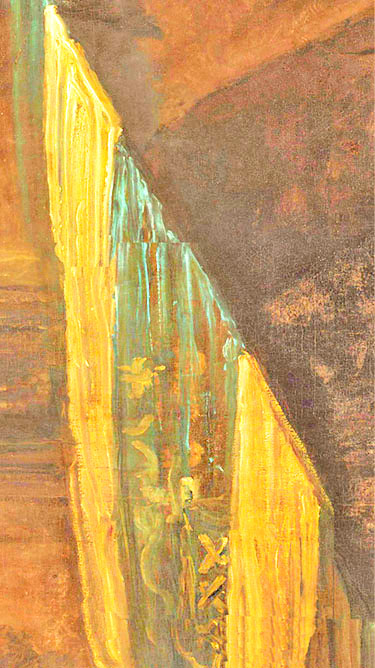
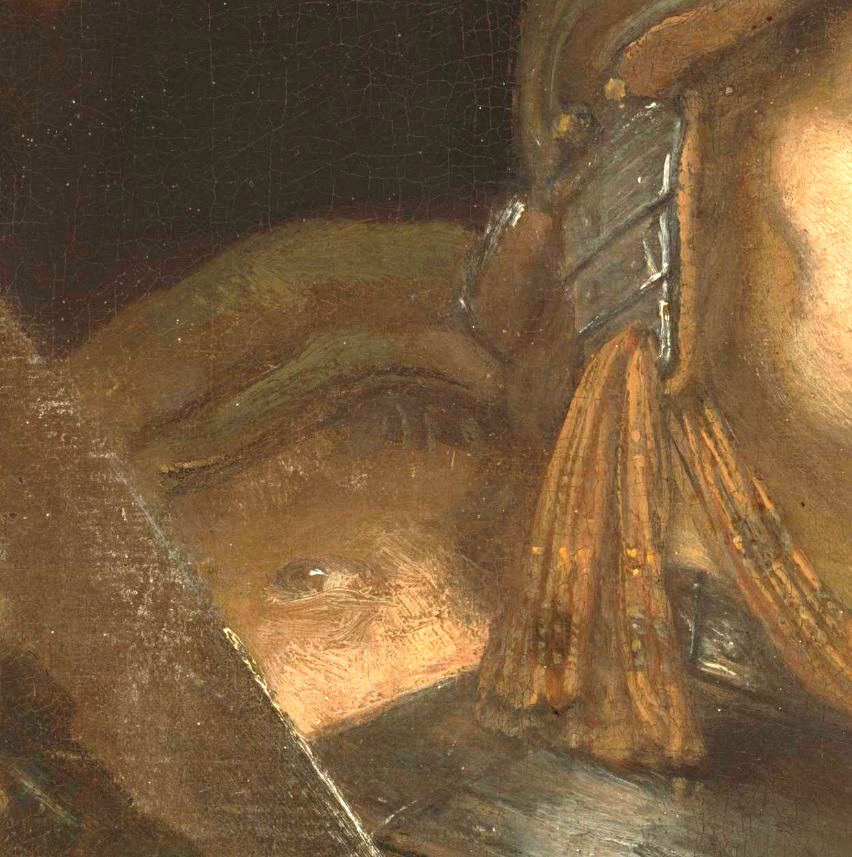
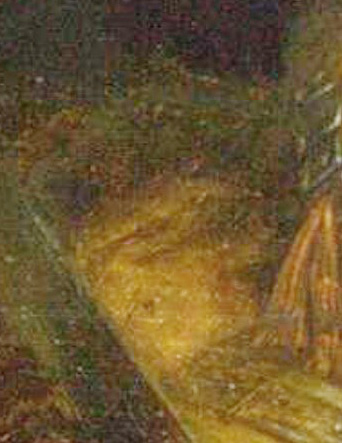
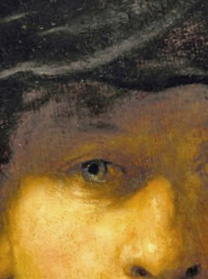
1st: Home; 2nd: by Rembrandt (1642); 3rd: by Lundens (1649); 4th: autoportrait (1634); 5th: autoportrait (1642).
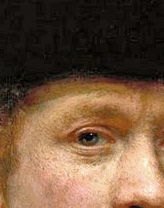
This single eye, peering out from between the civic guards Visscher12 and Cruijsbergen15, has kept experts occupied for a long time. Is it Rembrandt? He never wrote it down, of course. That would have made things far too easy.
Yet we know that cameos of this kind were common in large paintings. Militia painters such as Isaacsz and van der Helst also included themselves in the background.
Rembrandt is suspected of inserting his own face into many of his works. He is believed to have included himself e.g. as a sailor with Christ in a storm on the sea of Galilee (1633 - stolen in 1990), and as the Prodigal Son in the Brothel (1635), so it would almost be strange if he had not slipped himself into The Night Watch somewhere.
The color and clarity of this eye are very similar to those in Rembrandt's self-portrait from 1634, and the peaked hairline is also characteristic. In the original painting, a bit of fluff seems to float in front of the face. Since this does not appear in the copy by Lundens, it is probably the result of wear and tear rather than a mysterious artistic choice. Lundens even hints at a little more of the face, including part of the left eye.
Rembrandt knew his own eyes intimately after dozens of self-portraits, so reusing an earlier sketch to place himself discreetly among the guards would have been the simplest solution.
What is he looking at? Not at the viewer, and not at the main figures Banninck Cocq16 or Ruytenburch21. Judging by the position of the pupil, he looks upward to the left, toward the Amsterdam flag or toward the light.
The latter is a good candidate, given the unusual distribution of light in the painting. Nineteenth-century writers argued, based on other works by Rembrandt, that the background of The Night Watch represents a city gate and that the light was partly blocked by a drawbridge located at the front left.
If so, Rembrandt may be looking toward the one thing he always cared about most: the light source.