Side viewing civic guard
1st: Home; 2nd: by Rembrandt (1642); 3rd: by Lundens (1649).
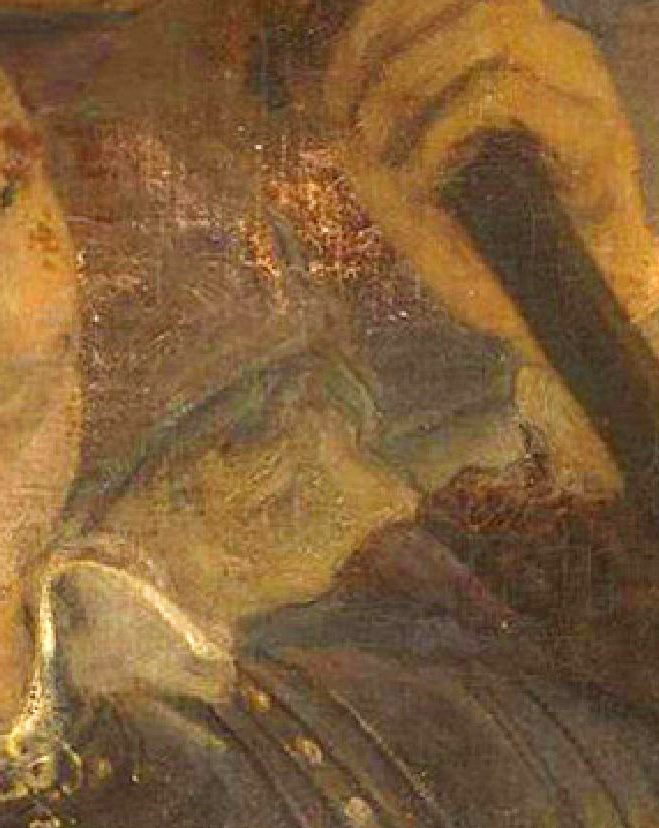
This unnamed civic guard stands between the shield bearers Ockersen18 and Schellingwou22.
There is no indication of his specific task. His helmet is visible enough to confirm that he belongs to the civic guard, but nothing in his posture or equipment reveals a defined role.
His presence is modest, almost accidental, yet carefully placed by Rembrandt to enlarge the apparent size of the militia company beyond the eighteen paying members. He is one of the anonymous figures who give the group its sense of depth and bustle.
He looks sideways toward the tip of Schellingwou's pike. This is not the direction taken by the oak-leaf musketeer14, whose blank shot cuts across the composition. The unknown guard seems more concerned with the vertical forest of weapons than with the horizontal chaos of gunfire.
His body is almost entirely hidden behind Ockersen's shoulder, and the visible part of his face is no wider than the white lapel in front of him. His helmet begins exactly at the top of that lapel, at Ockersen's chin height, suggesting an older man whose features are partly swallowed by shadow.
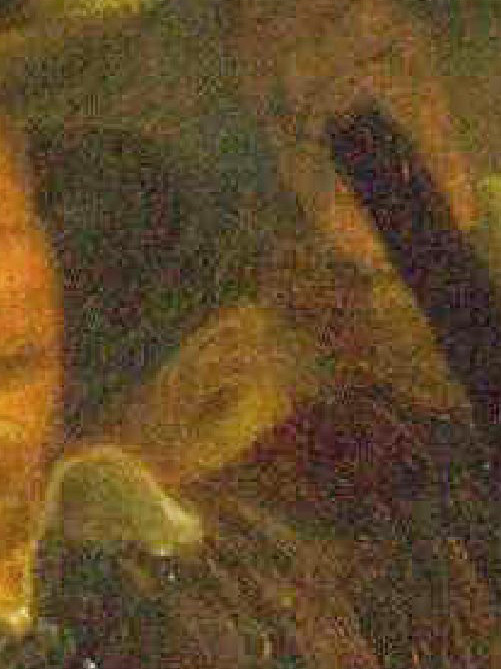
In Gerrit Lundens' copy of The Night Watch from 1649, this anonymous figure appears slightly higher in the composition, by about 2.5 centimeters. The helmet still begins at the top of Ockersens lapel, but Lundens' version extends the lapel upward, covering more of Ockersen's chin. The visible portion of the unknown man's face is even smaller than in Rembrandts original.
Lundens seems to have copied the painting in six vertical sections, beginning on the left side, which stood in a corner of the great hall of the Kloveniersdoelen, and working toward the center of the hall. A misinterpretation of this man's position early in the process propagated through the rest of the copy, affecting Schellingwou's placement and even the angle of his pike.
It is worth remembering that Lundens was working from the floor of a dimly lit hall, looking up at a four-meter-high canvas. Easy reference marks for us, such as a white lapel or a chin, may not have been clearly visible to him at the time. It is unlikely he was allowed to build a scaffold to improve his vantage point.