Musketeer shouldering his gun
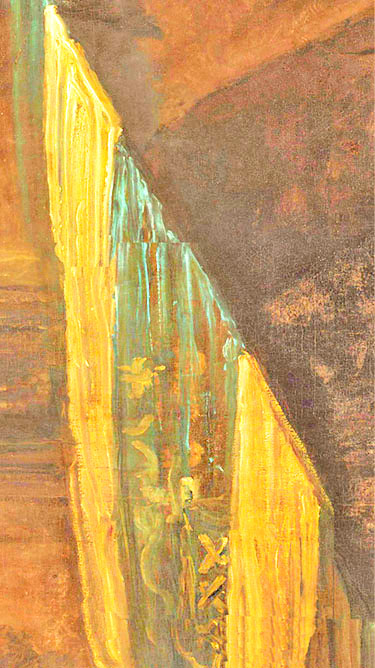
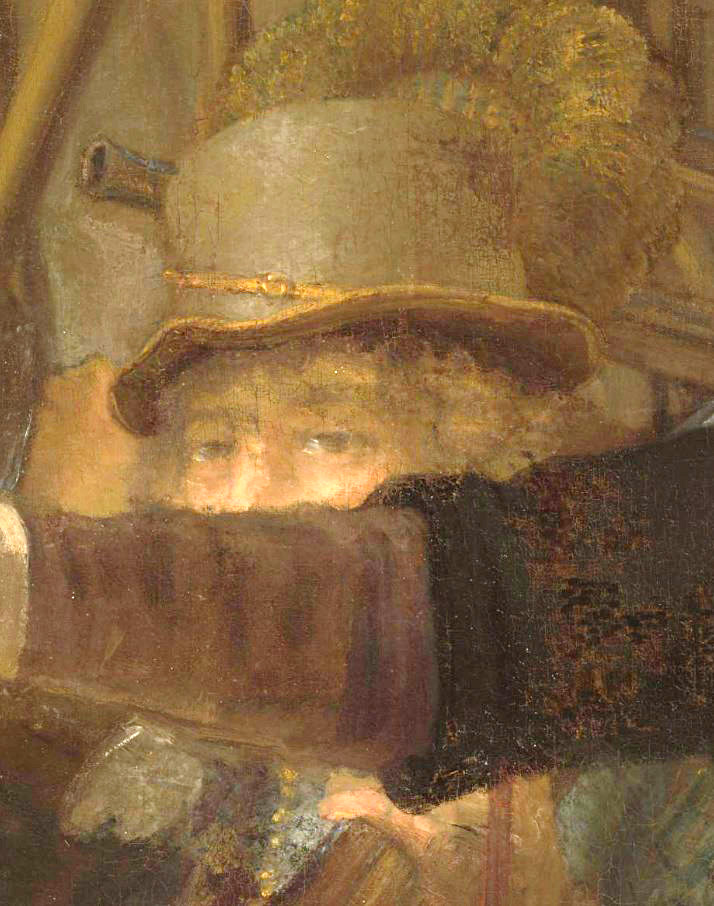
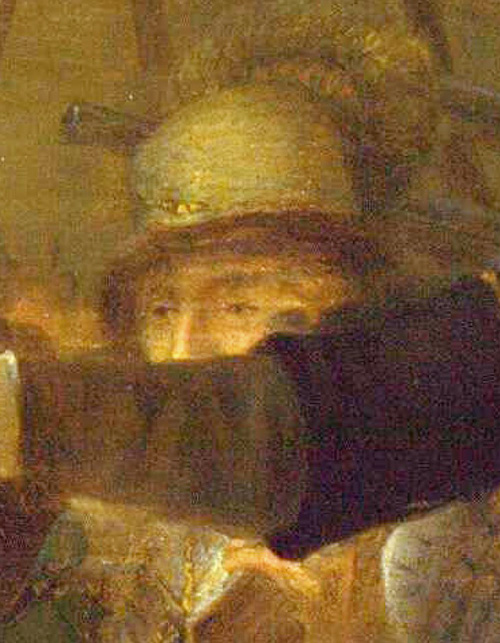
1st: Home; 2nd: by Rembrandt (1642); 3rd: by Lundens (1649).
This musketeer, wearing a greenish leather hat with feathers, would have been clearly visible if Rembrandt had not decided to place Sergeant Kemp's27 outstretched arm directly in front of his face.
It is a remarkable choice. Had Rembrandt painted Kemp’s hand only a little lower, this musketeer would be famous today. Rembrandt would not have obscured him like this if he had been one of the paying guards.
Another possibility is that Rembrandt enjoyed the idea of using Kemp’s arm to introduce an unrecognizable musketeer. If this man was an acquaintance, included for amusement, the two of them would have shared a private joke every time he entered the Kloveniersdoelen.
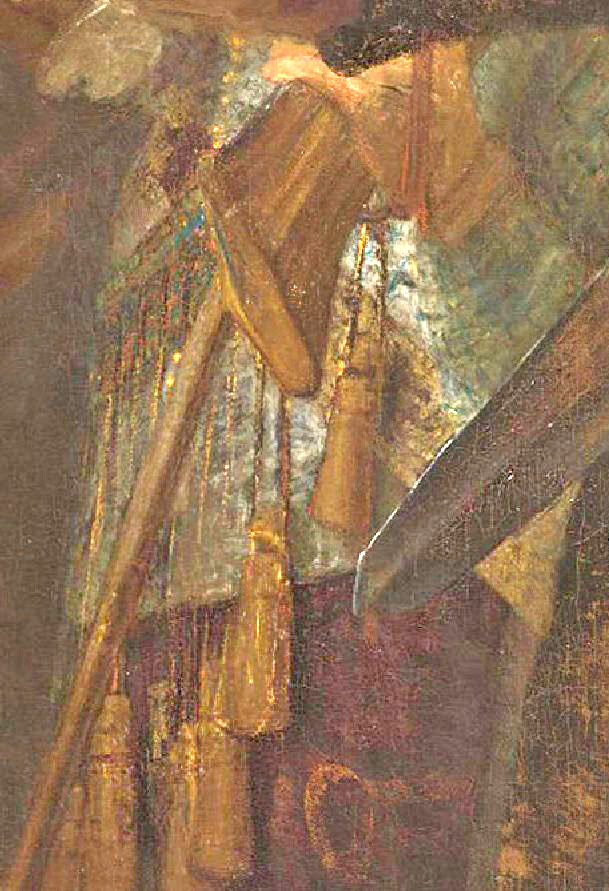
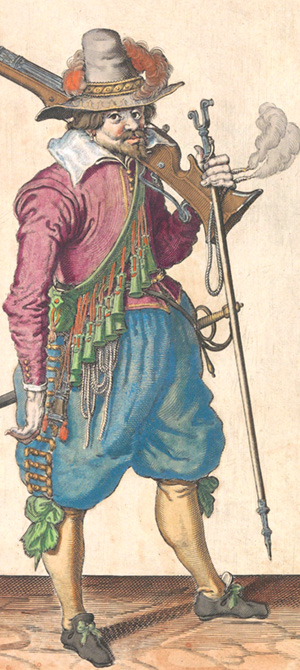
by de Gheyn (1607)
Rembrandt certainly gave this figure more attention than Bronchorst04 or Wormskerck05, and except for the hidden lower part of his face, he is depicted with far more care than Willemsen06, who paid his full hundred guilders.
His blue jerkin is finely decorated, the powder apostles are painted with detailed cords, and as a true Klovenier he holds his musket correctly at the stock.
Unlike some of the other musketeers, he appears to follow the rules for shouldering a musket from de Gheyn’s 1607 manual. We cannot see the burning wicks in his left hand, but the wick cord is visible, and he holds his forquette in the same hand, exactly as prescribed.
As with several others in the painting, Rembrandt probably was inspired by de Gheyn's design for his depiction of this unknown mustketeer.
A greyish token just below Kemp’s arm may be a marksman’s badge, similar to the one worn by Leijdeckers23, suggesting that this civic guard was considered an expert shot. It must have been a small man: Rembandt placed him on the first step of the gate building, but he is still considerably smaller than Kemp.
Gerrit Lundens, working on a much smaller canvas, did a respectable job of preserving many of Rembrandt’s details.
This unknown musketeer remains one of the small enigmas of The Night Watch: carefully painted, partially hidden, and perhaps included with a wink from Rembrandt to someone he knew.