Rembrandt's signature (1642)
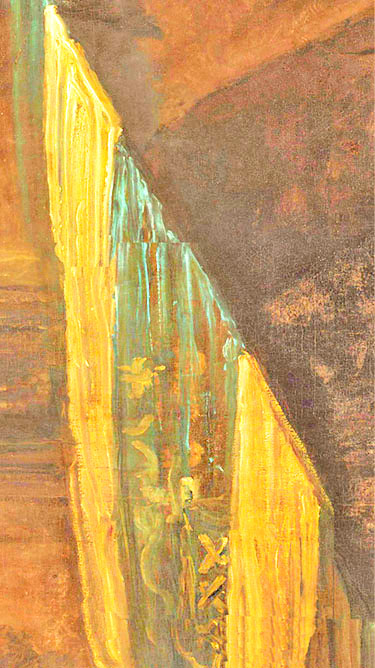
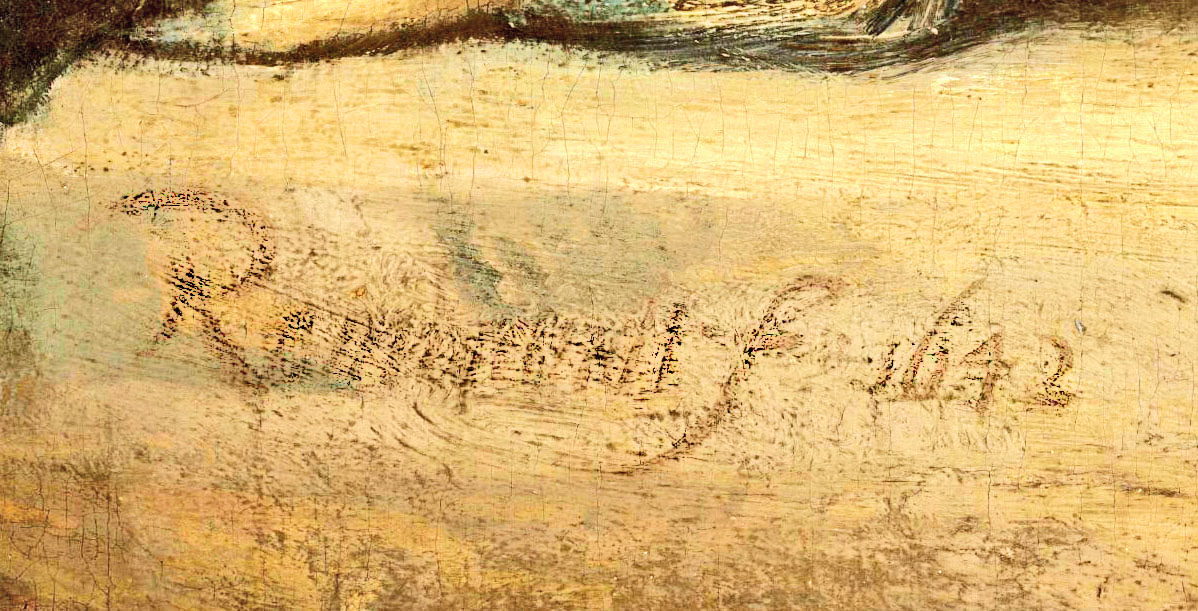
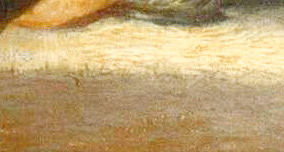
1st: Home; 2nd: by Rembrandt (1642); 3rd: Signature area on Lundens copy (1649).
In the middle of the original canvas, just below the feet of the girl in the golden-yellow dress (very likely Rembrandt’s wife Saskia in symbolic form), the painter left his unmistakable mark:
Rembrandt f. 1642
The “f.” stands for fecit — “made by” or “completed.”
A modest Latin flourish for a man who otherwise preferred bold gestures.
If the enormous canvas — five meters wide and over four meters high — had stood directly on the studio floor, Rembrandt would have needed to squat like an weightlifter to sign it. More likely, the painting stood on a raised platform at least a meter high, saving both his knees and his dignity.
The canvas itself was too large for Rembrandt’s studio. Some sources claim he built a temporary extension to accommodate it; others suspect he painted it on location in the Kloveniersdoelen, the militia headquarters. Either way, this was not a painting you casually propped against a wall.
The work was completed before the death of Saskia van Uylenburgh on 14 June 1642, eight months after giving birth to their son Titus. This timing later became legally relevant: in 1659, Titus’s guardian demanded proof from Cruijsbergen15 and Bronchorst04 that they had paid for the painting, ensuring it would not fall into Titus’s future inheritance. Even Rembrandt’s signature could not override Amsterdam’s paperwork.
Gerrit Lundens, who made the small and invaluable copy of The Night Watch, did not sign it. Although commissioned copies were sometimes signed, Banninck Cocq may have requested a faithful reproduction of Rembrandt’s original. This could also explain why Lundens painted over the later-added cartouche37 with the names.