The Night Watch city gate
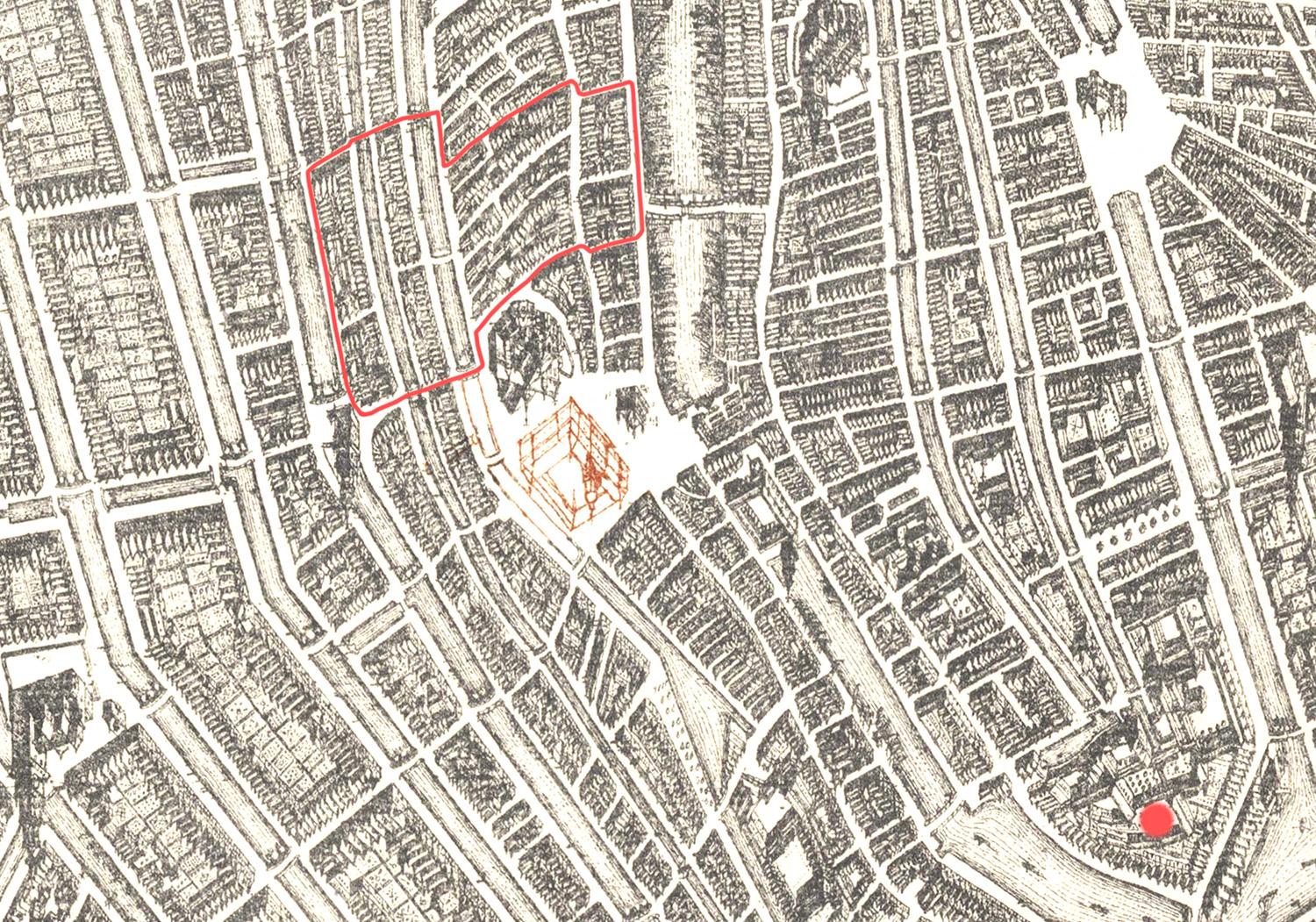
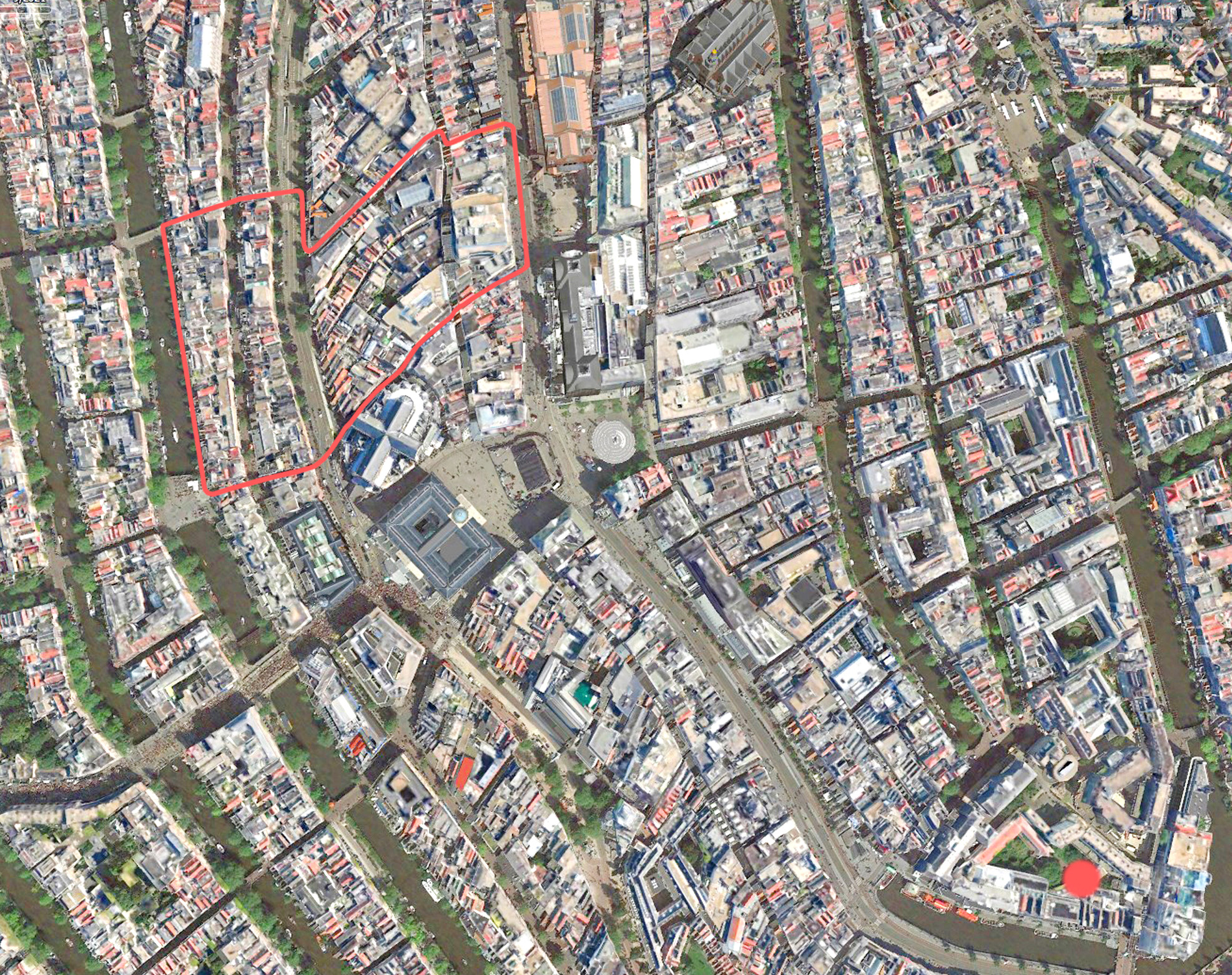
1st: Home; 2nd: District II in 1650; 3rd: District II in 2021 (North = up). A red spot marks the location of the Kloveniersdoelen. Click to enlarge.
Where exactly are these men marching?
This is one of the enduring mysteries of The Night Watch.
Under Captain Frans Banninck Cocq16, District II covered the area north of the Nieuwe Kerk, bordered by the Damrak canal to the east, the Singel canal to the west, and the Jan Roodenpoort tower at its southwestern corner. If the militia were to assemble anywhere, it would be somewhere in this district.
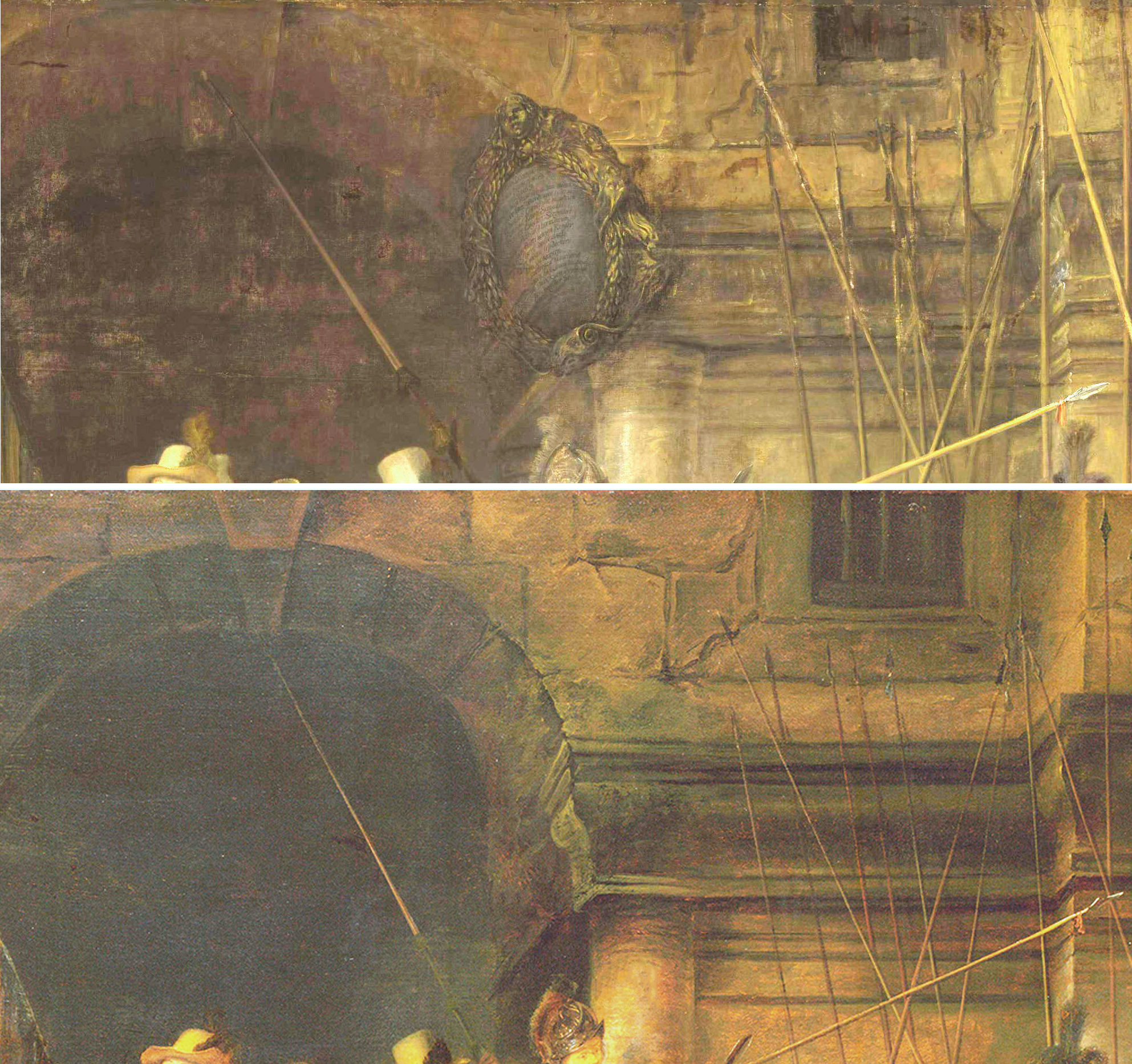
The background of the painting resembles a gatehouse.
The direction of the light, and the metal railing on the left, give the suggestion of a city gate with a drawbridge.
But then the problems begin.
The entrance has three steps: a charming solution to position the guardsmen, but completely impractical for a gate through which carts, horses, and supply wagons must pass. No Amsterdam city gate had such a staircase.
The façade itself does not match any known gate from Rembrandt’s time.
Most Amsterdam gates were wooden; the few stone ones do not resemble this structure. The sloping entrance, tilting left for defensive reasons, complicates matters further.
Even in the 17th century, this would have been an architectural oddity.
Some have suggested that Rembrandt borrowed elements from monumental portals or towers. Logical candidates include the Kloveniersdoelen’s own “Swygh Utrecht” gate, the St. Antonispoort (later the Waag), or the Haarlemmerpoort. But none of these match the painting, and all were outside District II.
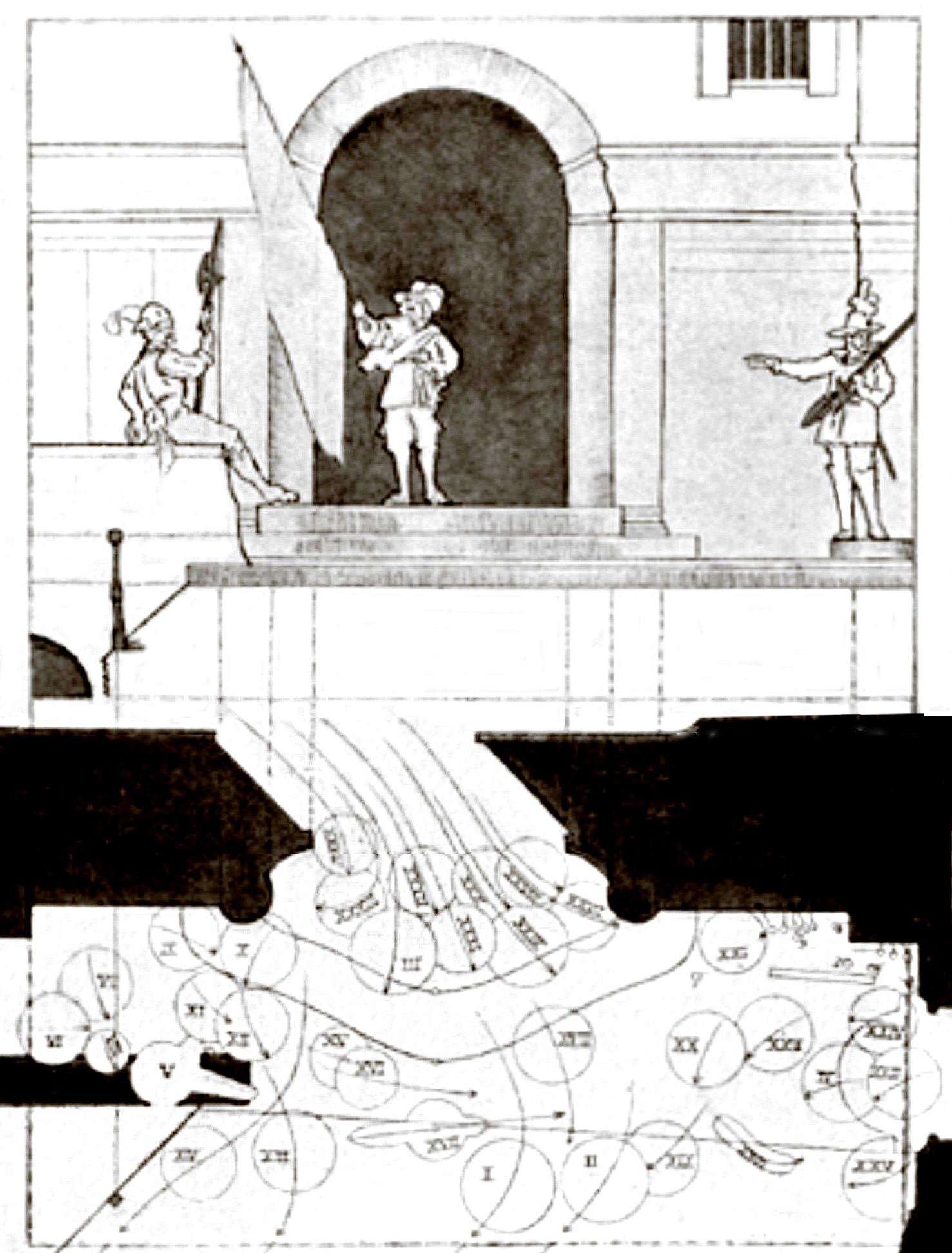
click to enlarge
Already in 1641, Rembrandt’s student Samuel van Hoogstraten complained that he wished his master had “shed a little more light on it” [which would also be applicable to his chiaroscuro].
The most likely explanation is also the simplest: Rembrandt invented his own gate, combining features from several real structures to create a dramatic backdrop. He did this frequently in his biblical and historical works. Architectural truth was always secondary to visual impact.
Schmidt-Degener's analysis
In 1917, the future Rijksmuseum director Frederik Schmidt-Degener published a detailed analysis in Onze Kunst.
He not only described Rembrandt’s deliberate perspective distortions but also produced a reconstruction of how the imaginary gate might have looked.
In a delightful overhead sketch, he mapped the positions of the figures and drew arrows indicating their likely movements — essentially predicting the chain reaction of chaos00 that would unfold if the militia actually tried to march in this cramped space. Rembrandt, who loved dynamic scenes, must have enjoyed staging this barely controlled commotion.
A new candidate: The Jan Roodenpoort Tower
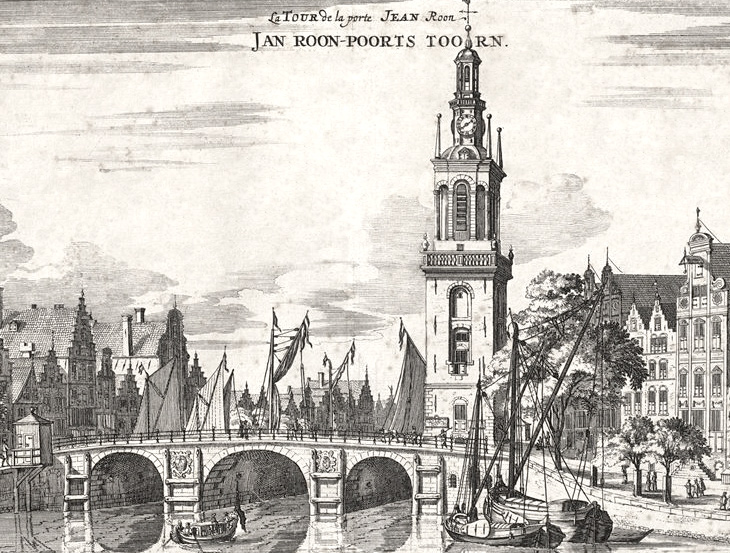
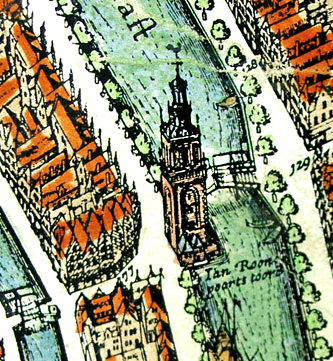
by Berckenrode (1625)
One structure has been surprisingly overlooked: the Jan Roodenpoort tower, which marked the southwestern corner of District II.
Built in 1480, it served as a gate in the medieval city wall and as a bridge, with locks, over the Singel canal.
In 1617, architect Hendrick de Keyser expanded it with a square base, adding militia quarters above and prison cells below. The windows in these upper rooms resemble the one in The Night Watch.
A wooden drawbridge once stood on its left side — similar to the bridge Rembrandt painted — and was replaced by a stone bridge in 1648 by Jan Leeghwater. The tower was demolished in 1829, but the prison cells still exist beneath the modern street.
The dramatic contrasts in Rembrandt’s painting may reflect shadows cast by houses on the opposite side of the canal, or perhaps the shadow of an open drawbridge, as Schmidt-Degener suggested.
Although Rembrandt certainly invented much of his architectural setting, the Jan Roodenpoort tower aligns with many elements in the painting. And importantly, it stood at the edge of District II — the perfect (and only) place for the militia to begin a ceremonial march.
Captain Banninck Cocq's attendance with his District II guardsmen at Maria de' Medici grand entrance in Amsterdam in September 1638 likely inspired him to ask Rembrandt for a monumental militia painting.
If Rembrandt wanted a backdrop worthy of this lavish civic spectacle for the queen mother of France, the Roodenpoort tower would have provided exactly the right mix of grandeur, symbolism, and local pride.