The Interactive Night Watch (by Rembrandt van Rijn and Gerrit Lundens)
Update: June 13, 2026
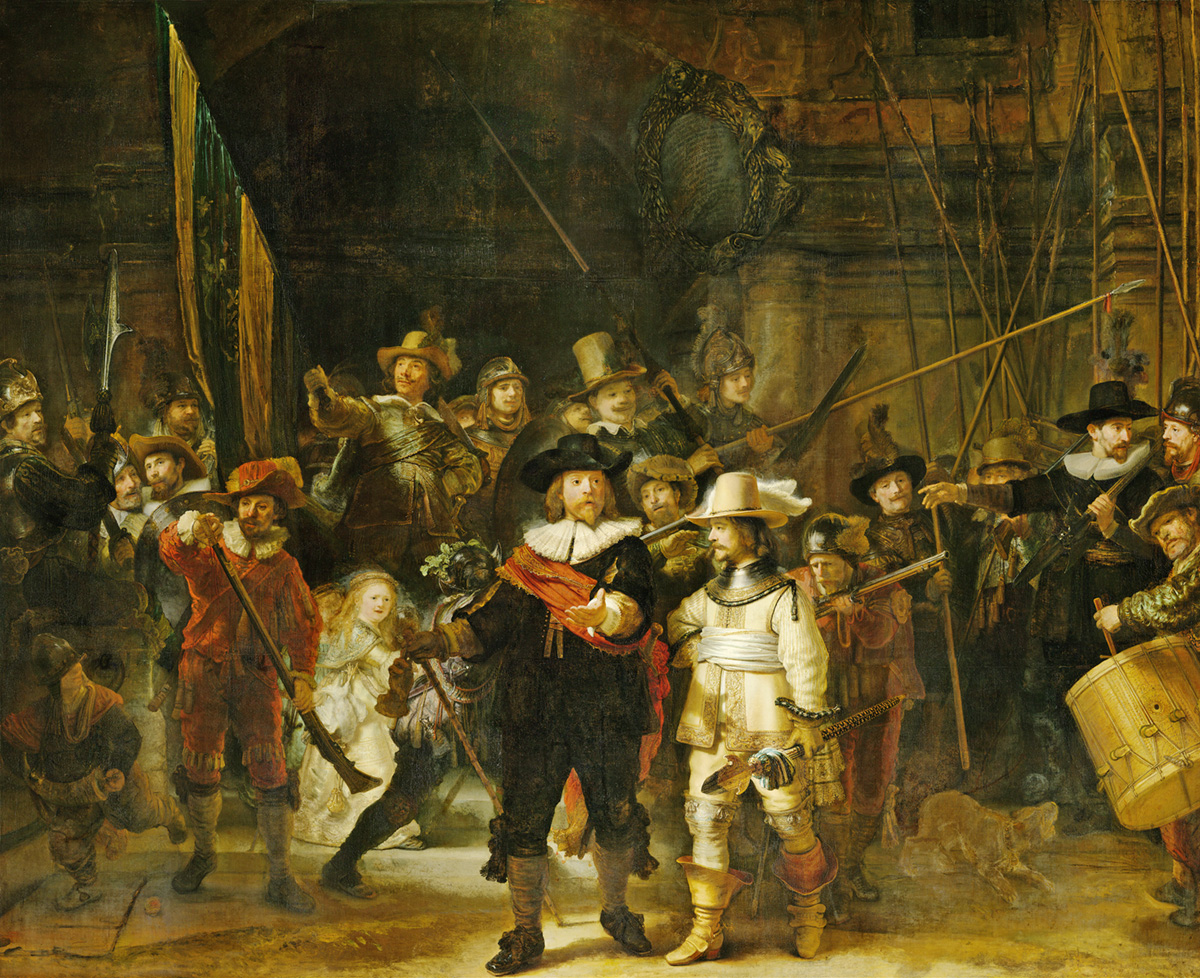
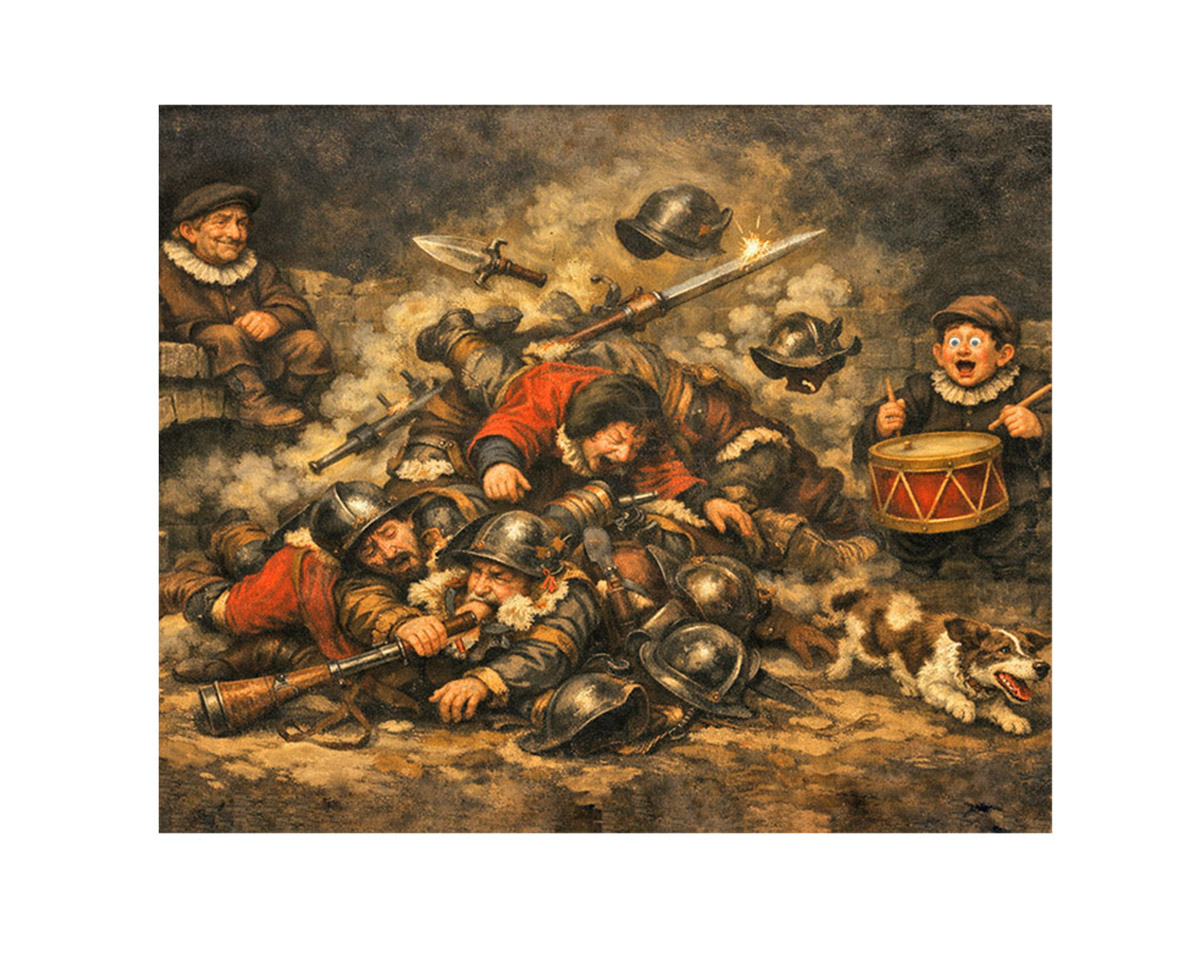
1st: The Night Watch (Rembrandt, 1715); 2nd: Dynamics of The Night Watch (what happened after).
PC: Move your mouse over a face to see the name, click to open the profile. Tablet / phone: Brief tap to show the name, long tap to open the profile.
The index page contains a numeric and an alphabetic list, with links to all profiles.
Introduction
Before photography arrived in 1839, the only way to display the importance of your network was to commission a painting. That is why Frans Banninck Cocq16, impressed by the glorious welcome by the militia of Maria de’ Medici in Amsterdam in 1638, approached his neighbor Rembrandt van Rijn13 in late 1639 with a request: portray his District II militia company in a way that would impress Amsterdam.
The result, completed in 1642 and now owned by the City of Amsterdam, hangs in the Rijksmuseum.
The Night Watch remained Rembrandt’s only civic guard painting. Other artists ( Govert Flinck, Bartholomeus van der Helst) received multiple commissions. This does not mean District II was unhappy with Rembrandt’s work. On the contrary, he received several portrait commissions from the same circles. But with The Night Watch, he made one thing very clear: he alone controlled the composition. Complaints about likenesses were not negotiable.
The painting's name and its size reduction
The original title was The Militia Company of District II under the Command of Captain Frans Banninck Cocq. Its later nickname, The Night Watch, arose because centuries of peat-fired stoves, smoke, and darkened varnish made the painting appear nocturnal; even though Rembrandt painted a daytime parade illuminated by his signature chiaroscuro.
Originally measuring 502 × 387 cm, The Night Watch hung in the Kloveniersdoelen, the militia’s headquarters, inn, and shooting range. In 1715, it was moved to the new Amsterdam Town Hall building on Dam Square. Unfortunately, the available wall space between two doorways was only 446 cm wide. The frame was removed, and the canvas was trimmed to 435 cm.
The consequences were dramatic. On the right, only a sliver could be removed: the drummer had to remain visible, so the main cut was made on the left, eliminating three figures: two militia members and a toddler.
The hall’s height (402 cm) was sufficient, but the city council insisted on maintaining the original proportions. In this disastrous decision, they also removed 20–40 cm from the top and bottom. The cropped painting became 437 × 363 cm.
The reduced version lost the compositional power of the original, in which the captain and lieutenant stride toward the illuminated center. Years of smoke, moisture, and misguided varnish attempts had darkened the canvas so severely that officials could no longer identify the militia district or the individuals portrayed. Later restorations revealed more details but also caused further deterioration. One historian remarked that The Night Watch has spent “several centuries in intensive care.”
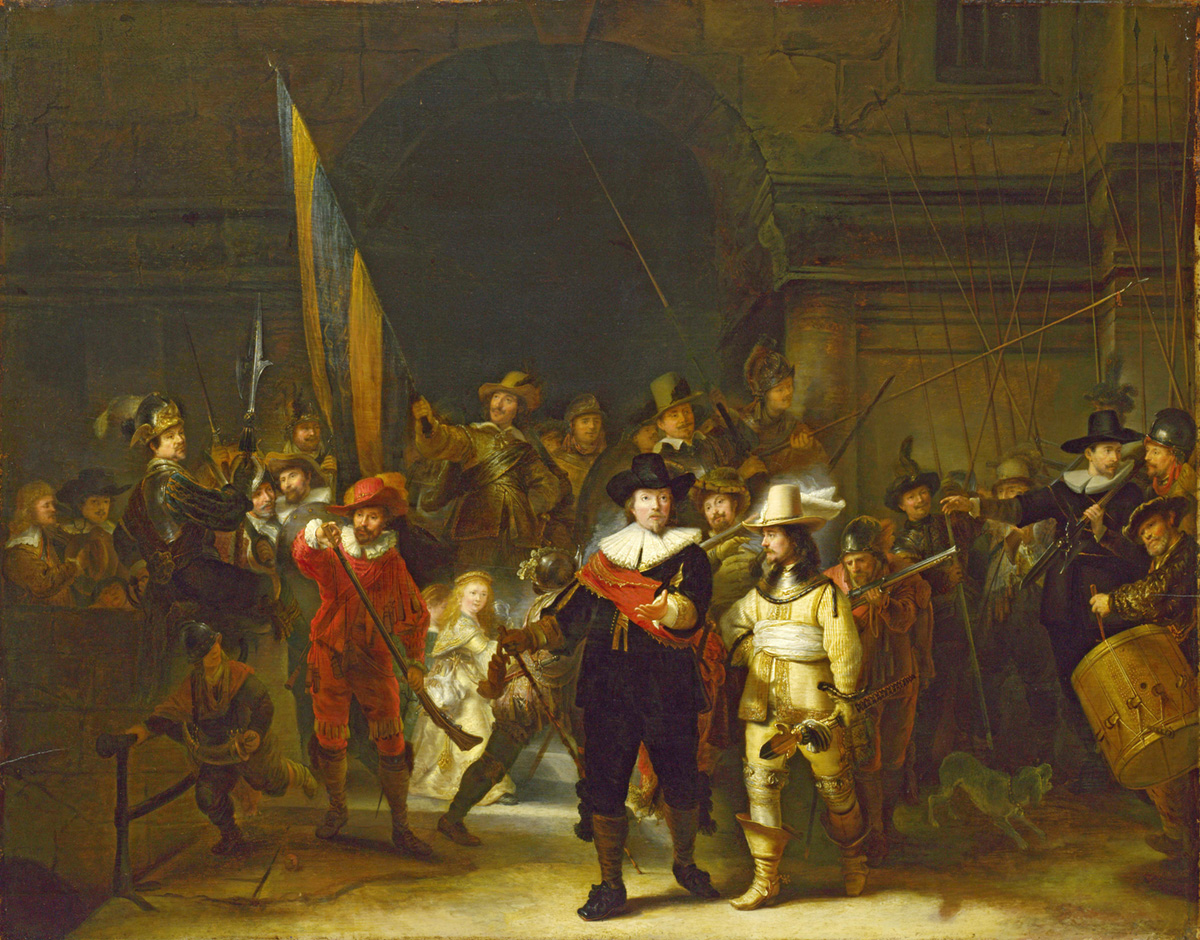
Gerrit Lundens' copy
Fortunately, at the request of Banninck Cocq, painter Gerrit Lundens (1622–1686) created a small copy (85.5 × 66.5 cm) in 1649.
This copy, now owned by the National Gallery in London and on long-term loan since 1958 to the Rijksmuseum, allows us to reconstruct the original composition.
Although Lundens’ copy is lighter than the original, it shows that Rembrandt never intended a bright daylight scene. Seven years at the Kloveniersdoelen cannot explain the later “night” appearance. Rembrandt’s monumental chiaroscuro, far stronger than in Lundens’ small copy, was designed to create a dramatic interplay of light and shadow.
Lundens’ version is not perfectly accurate. Some figures — especially those higher up — differ slightly in position. Copying a five-meter painting in a dimly lit hall was not an easy task.
For this interactive project, I blended both versions, giving priority to Rembrandt’s original while increasing exposure in shadow areas to improve visibility. This blend was not produced by neural AI but by human intelligence: a system which still operates with several orders of magnitude more neurons and a more reliable sense of nuance.
The index page contains a numeric and an alphabetic list, with links to all profiles.
History of this interactive version
My first interactive version of The Night Watch was created in December 2021 as a one-week proof-of-concept for my Une Soirée au Louvre research project. Now that the latter is largely complete, I have applied the updated design to The Night Watch. Several adjustments were necessary: the Rijksmuseum’s former 700-gigapixel open-access image has been replaced by a commercial cloud service without mouse-control or ultra-high resolution. I therefore switched to the Google Arts & Culture version.
For details on other art projects, visit my Antartica Galleries site.
Suggestions and comments are always welcome.
© Gert Nieveld, Amsterdam, December 2022 - June 2026