Face of unidentified man
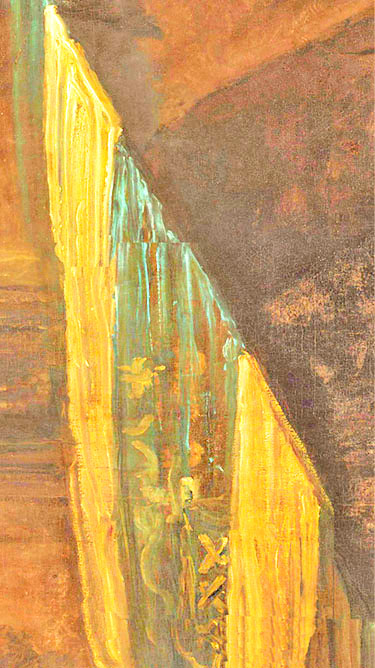
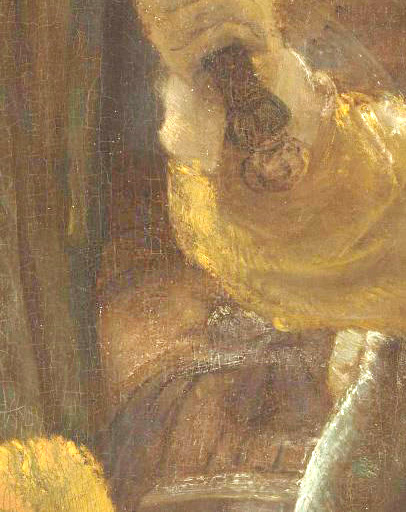
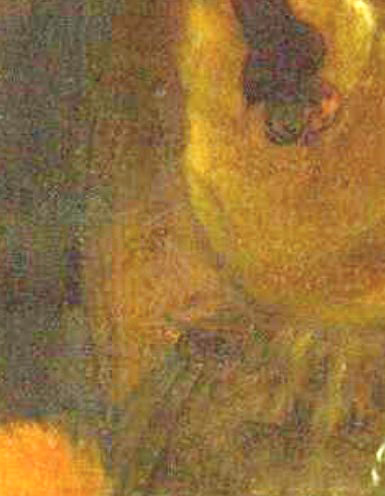
1st: Home; 2nd: by Rembrandt (1642); 3rd: by Lundens (1649).
To the right of the city banner, in both the original painting and the copy by Lundens, a small part of a man's face appears. Only the right eye is visible, along with a hint of his nose and mouth, or a mustache as suggested by Lundens.
With such a tiny fragment, recognition is practically impossible. It is unlikely that he was a non-paying civic guard. Rembrandt did not usually add half-hidden figures simply to suggest a crowd.
In large paintings, these small cameos are often reserved for people connected to the work but not part of the official subject. For example, an assistant to the painter, or someone who helped the civic guards.
One possible option is that this is the innkeeper of the Kloveniersdoelen, Nagtglas, watching his granddaughters in the blue08 and yellow09 dresses as they skip between the ranks of the guards. The position is well chosen. None of the other partially visible figures in the painting, including Rembrandt's own cameo13, have such a clear overview.
These kinds of cameos often served as inside jokes between the painter and the people involved. With The Night Watch positioned on the wall of his Kloveniersdoelen for many years, it must have raised a smile on the face of innkeeper Nagtglas every time he passed it.
A more speculative theory, proposed by George Boka in 1994, suggests that Rembrandt used kabbalistic ideas to turn the militia piece into a memorial for his wife and unborn children. In this theory, the lines of symmetry in the painting relate to Rembrandt's personal tragedies. The key claim is that Rembrandt looks at his wife and children from several places in the painting, and that this unidentified man is also Rembrandt.
It is an interesting idea, although never validated, and perhaps best enjoyed with the same caution one uses when approaching a musket being loaded by an enthusiastic amateur07.